How to Make a Paper Maché Corazón — and Why It Means More Than You Think
Updated: Apr 19
There’s a reason the heart shows up everywhere in Mexican folk art. On tin walls in San Miguel de Allende. Stitched into textiles. Painted onto retablos. Pinned with milagro charms at roadside shrines. The corazón isn’t decoration — it’s a language. And once you understand what it’s saying, making one with your own hands becomes something different entirely.
This post walks you through the full process of building a paper maché corazón from scratch, including the mud recipe we use in our workshops. But first, the meaning behind what you’re making.

The Corazón in Mexican Tradition
The heart has carried deep significance in this culture long before paper and paint. Pre-Hispanic peoples understood it as the center of life energy — the place where a person’s spirit truly lived. The Mexica believed the heart contained a person’s soul, their teyollia — their animating force. It wasn’t just a pump. It was the seat of everything that made someone who they were.
As Indigenous and Spanish traditions wove together over centuries, the corazón became a bridge: between the living and those who have passed, between grief and gratitude, between memory and celebration. In Día de los Muertos, a decorated heart isn’t decoration. It’s a conversation with someone you love.
That blending of traditions is why the folk art corazón looks the way it does — layered, expressive, and full of symbols that each carry their own meaning.
What the Symbols Mean
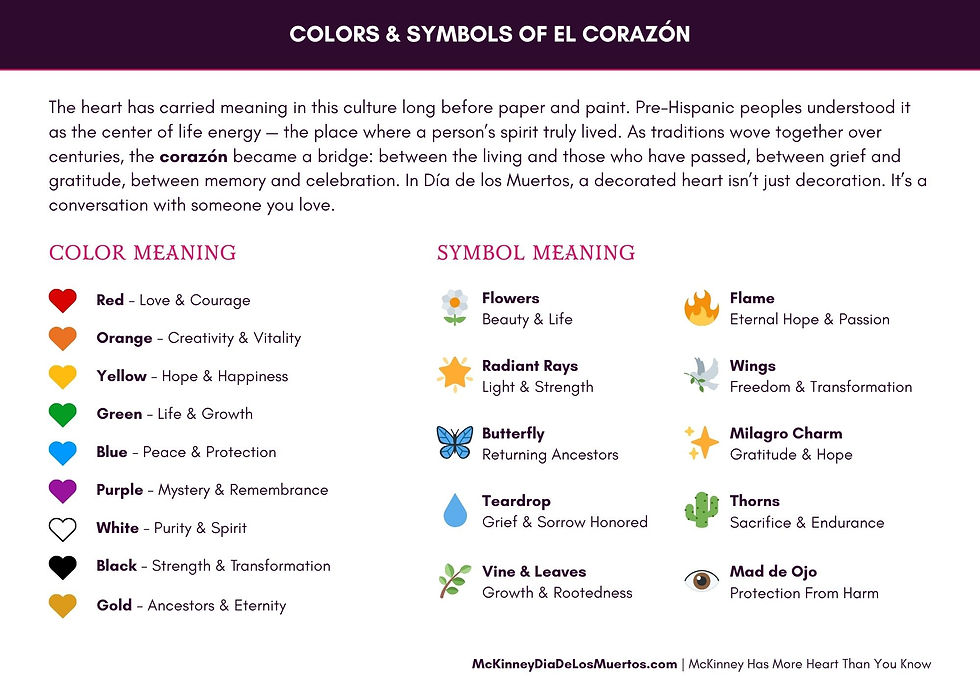
When you decorate your corazón, every element you choose is part of the language. Here’s what the most common symbols represent:
Flame — Eternal hope, passion, and love that never burns out. The flame is the most recognized element of the folk art heart and one of the oldest.
Radiant Rays — Light and strength radiating outward from the heart. The heart as a source of energy for everyone around it.
Flowers & Marigolds — Beauty, life, and remembrance. Marigolds — cempasúchil — are the flower of Día de los Muertos. Their bright color and strong scent were believed by the Aztecs to guide spirits back to their loved ones.
Wings — Freedom, transformation, and the spirit’s journey beyond this world.
Thorns — Across cultures and centuries, a symbol of sacrifice and endurance. The heart that has carried pain and kept loving.
Teardrop — Grief held honestly. A reminder that sorrow and love are not opposites — they live in the same place.
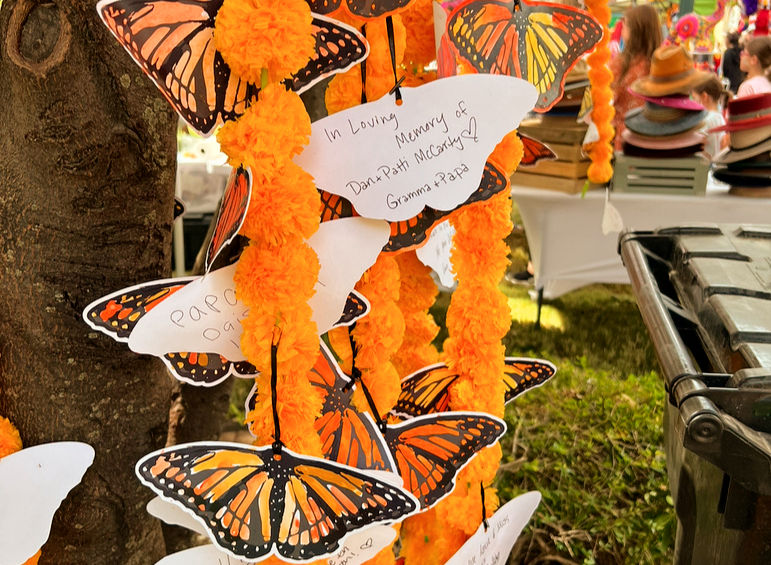
Butterfly — Returning ancestors. Monarch butterflies arrive in Mexico each fall right at Día de los Muertos, and have long been believed to carry the spirits of the departed home.
Milagro Charm — Small metal amulets meaning miracle. Traditionally pinned to hearts as offerings of gratitude, hope, or a deeply held wish.
Mal de Ojo — The evil eye. A protective symbol found across many cultures, woven into Mexican folk art to ward off harm and watch over the people we love.
Vines & Leaves — Growth, rootedness, and the natural cycle of life and death. A reminder that everything living is also always returning.
There’s no wrong combination. The corazón you make reflects what you’re carrying — who you’re honoring, what you’re hoping for, what you want to hold onto.
What the Colors Mean
Color in Mexican folk art is never accidental. Every shade carries intention. Here’s a guide to help you choose yours:
Red — Love & Courage
Orange — Creativity & Vitality
Yellow — Hope & Happiness
Green — Life & Growth
Blue — Peace & Protection
Purple — Mystery & Remembrance
White — Purity & Spirit
Black — Strength & Transformation
Gold — Ancestors & Eternity
Mix them freely. Layer them boldly. The colors you reach for will tell their own story.
Download our Symbolism PDF
How It Works
This project has two parts that come together as one piece. You’ll build and paint a three-dimensional paper maché heart, then attach it to a painted canvas — adding finishing details that bring the whole composition together. Think of the canvas as the world your heart lives in. What surrounds it, what colors you choose, what symbols you place around it — all of it adds meaning.
No two pieces will look alike. That’s the point.
What You’ll Need
For the heart form:
A printed or hand-drawn heart pattern
Lightweight cardboard (USPS priority mail boxes or Amazon boxes work perfectly)
Pre-crumpled packing paper
Masking tape
For the mud:
1 1/4 cups shredded damp toilet paper
1 cup premixed drywall joint compound (in a plastic tub)
3/4 cup Gorilla Wood Glue
1/2 to 1 cup white flour (start with 1/2 cup and adjust for consistency)
2 tablespoons mineral oil (optional — adds smoothness and flexibility)
For the canvas and finishing:
A canvas in your chosen size
Acrylic paint in your chosen colors
Detail brushes, paint pens, metallic paint
Strong adhesive or hot glue to attach the heart to the canvas
Decorative elements: rhinestones, mini paper flowers, milagro charms, ribbon or twine
Step 1 — Build Your Heart Form
Cut out your chosen heart pattern and glue it onto lightweight cardboard. This is your base.
Shape pre-crumpled packing paper into the dimensional form you want and use masking tape to secure it firmly to the cardboard. Take your time here — the stronger your form, the better the finished heart will look and hold once it’s on the canvas.
Download Heart Patterns
Step 2 — Mix Your Mud
Combine all mud ingredients and mix until smooth — the consistency should feel like thick frosting. Add more flour if the mixture is too wet. Make your mud fresh each session; it doesn’t store well once mixed.
Step 3 — Apply the Mud
Cover your heart form with a thin, even coat of the mud mixture. Work it into all the curves and edges. Thinner coats dry more evenly and are less likely to crack. Smooth as you go — this is your chance to refine the shape before it sets.
Step 4 — Dry It Out
Use a blow dryer on a low or medium setting to speed up drying, working in sections and smoothing any rough spots as the surface sets. For best results, let it air dry overnight before moving on.
Step 5 — Sand and Paint the Heart
Once fully dry, lightly sand any rough spots if you want a smoother finish — or leave the texture as-is. Apply a solid base coat of acrylic paint and let it dry completely before adding detail work.
Use the symbol and color guides above to choose what goes on your heart. Paint pens work beautifully for fine line work. Metallic paint brings rays, flames, and accents to life.
Step 6 — Paint Your Canvas
While your heart dries, turn to your canvas. This is where the broader story lives. Some people painted a full scene — sky, landscape, florals, geometric patterns. Others kept it simple, using color and texture to create atmosphere. There’s no right approach.
Consider the symbols and colors you’ve chosen for your heart and let those guide what surrounds it. A heart full of marigolds might live in a field of gold. A heart with wings might have open sky behind it. Follow what feels true to what you’re making and who you’re making it for.
Step 7 — Bring It Together
Once both the heart and canvas are dry, attach the heart using strong adhesive or hot glue. From here, add your finishing details — to the heart, to the canvas, or both. Rhinestones, paper flowers, milagro charms, painted details that connect the heart to its surroundings. This is the most personal part of the process. Let it be.
Make Art With Us
Our paper maché corazón workshop has passed, but be on the lookout for more ways we are bringing the Year of The Heart alive with community and crafts!
If you post your work on social we'd love for you to share it with us. Tag @mckinneydiadelosmuertos or #mckinneydiadelosmuertos #mckinneyhasheart
Follow us on Instagram and Facebook @mckinneydiadelosmuertos to be the first to know, or check back here for updates.